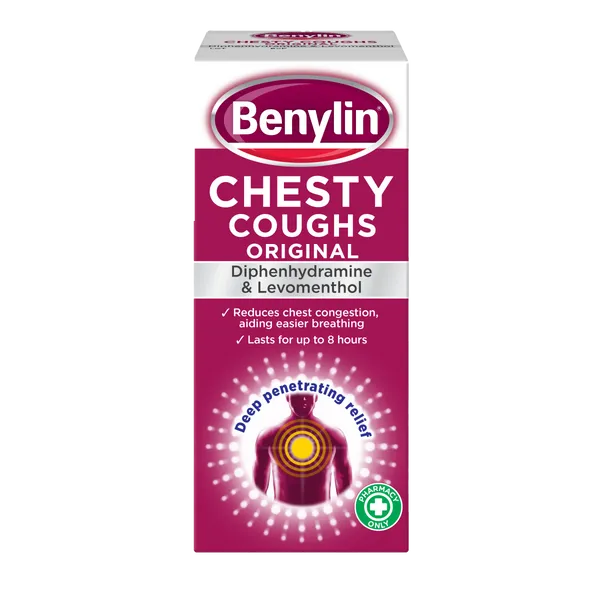
Do not use Benylin Chesty Coughs Original 300ml:
- If you have ever had a bad reaction to any of the ingredients.
- If you have had a cough for a few weeks that may be caused by asthma, or a cough which brings up a lot of mucus (phlegm).
- If you are taking, or have taken in the last two weeks, drugs for depression known as Monoamine Oxidase Inhibitors (MAOIs).
- For children under 12 years old.
- To make a child sleepy.
If any of these apply to you or your child, get advice from a doctor or pharmacist without using Benylin Chesty Coughs Original 300ml.
Talk to your doctor or pharmacist:
- If you suffer from liver or kidney problems.
- If you have a persistent cough such as occurs with bronchitis or emphysema; have asthma; are suffering from an asthma attack; or have a cough that produces a lot of mucus (phlegm).
- If you have difficulty with passing water or prostate problems (which may mean you need to pass water often).
- If you may have narrow-angle glaucoma (increased pressure in the eye).
- If you are taking alcohol.
- If you have an intolerance to some sugars.
- If you are taking any other medicines containing diphenhydramine including any creams, ointments or gels.
- If you are taking any other medicines, including:
- Opioid analgesics (drugs used to relieve pain e.g. codeine, tramadol, morphine).
- Anticholinergic drugs e.g. antidepressants (drugs to treat mood disorders), atropine (used to treat some eye conditions and occasionally bowel conditions).
- Minor tranquillisers (drugs used to relax muscles or decrease anxiety).
- Sleeping tablets including barbiturates.
- Antipsychotics (drugs used to treat delusions, hallucinations or confused thoughts).
If you are not sure about any of the medicines you are taking, show the bottle or pack to your pharmacist. If any of these bullet points apply to you now or in the past, talk to a doctor or pharmacist.
Pregnancy and Breast-feeding:
Ask your doctor or pharmacist for advice before taking this medicine if you are pregnant or breast-feeding, think you may be pregnant or are planning to have a baby.
Special warnings about this medicine:
This medicine may cause drowsiness. If affected, do not drive or operate machinery. Avoid alcoholic drink.
Some of the ingredients can cause problems:
- This medicine contains 1 g sucrose and 3.5 g liquid glucose per 5 ml. This should be taken into account in patients with diabetes mellitus. If you have been told by your doctor that you have an intolerance to some sugars contact your doctor before taking this medicinal product.
- This medicinal product contains 197 mg of alcohol (ethanol) in each 5 ml. The amount in 5 ml of this medicine is equivalent to less than 5 ml beer or 2 ml wine. Harmful for those suffering from alcoholism. To be taken into account in pregnant or breast-feeding women, children and high-risk groups such as patients with liver disease or epilepsy.
- Ponceau 4R (E124) may cause allergic reactions.
- This medicinal product contains 16.61 mg sodium per 5 ml. To be taken into consideration by patients on a controlled sodium diet.
If you experience any of the following, stop using the medicine and seek immediate help:
- Swelling of the face, lips and/or tongue.
- Allergic reactions including skin rashes (which may be severe and include blistering or peeling of the skin) and itching.
- Fits or numbness (paraesthesia).
If you experience any of the following, stop using the medicine and talk to your doctor:
- Increased awareness of heart beat (palpitations).
- Shakiness (tremor).
- Difficulty passing water.
Other effects which may occur include:
- Very common (may affect more than 1 in 10 people): Drowsiness.
- Common (may affect up to 1 in 10 people): Dizziness, headache, excitability, slowness in movement or speech, blurred vision, unusual weakness, thick phlegm, dry mouth, nausea, vomiting.
- Uncommon (may affect up to 1 in 100 people): Irritability, hallucinations, nervousness, agitation, pins and needles (paraesthesia), sedation, ringing in the ears (tinnitus), a fast heartbeat, chest discomfort, low blood pressure, dry nose.
- Rare (may affect up to 1 in 1,000 people): Blood disorders, confusion, depression, involuntary movements, difficulty sleeping, shakiness (tremor), irregular heartbeat, increased awareness of heartbeat (palpitations), liver problems.
If you experience any side-effects not included above or are not sure about anything, talk to your doctor or pharmacist. You can also report side-effects directly via the Yellow Card Scheme at www.mhra.gov.uk/yellowcard or search for MHRA Yellow Card in the Google Play or Apple App Store.
Storage Information:
- Do not store above 25°C.
- Discard the bottle 4 months after opening, even if there is syrup remaining.
- Keep the product out of the sight and reach of children.
- Do not use your medicine after the date shown as an expiry date on the packaging.
- Medicines should not be disposed of via wastewater or household waste. Ask your pharmacist how to dispose of medicines no longer required. These measures will help to protect the environment.